The school we know tends toward functional specialization, separation between life and work, production and leisure. But scholé, the Greek root of school, meant not just discussion but also ócio: a slow, idle time where an interesting conversation could happen. proposes the opposite of know-how. It proposes no-how. an absence of fixed method, a non-prescriptive não-como. The "how" is not known in advance. It changes role, function, meaning. It might hold several at once. It is performative. It cannot be regulated, institutionalized, quantified, or capitalized. Why have utopian educational models—Bauhaus, Black Mountain College, Atelier Livre—never become permanent? Perhaps because the moment something is instituted, it loses freshness, currency, decays, and dies. The actual, the urgent, is always provisional. Espaços-quaisquer. This school is not an institution. It is a foundation for action: a provisional exercise, not efficient, not productive, in transition, for nothing. A place where education is not preparation for life but life already happening—through art, through performance, through the creative use of leisure. We don't finish students. We hand them a living network and permission to remain unfinished. The Unfinished School is for nothing. And therefore, for everything.

You have real power

This school is not run by adults on behalf of students. Every student has an equal voice in decisions that affect the school — including rules, budget, use of spaces, and the direction of projects. Decisions are made together in weekly open meetings, where every voice counts the same regardless of age or experience. This is not symbolic participation. If you propose something and the group agrees, it happens. If you disagree with a rule, you can challenge it. Power here is real, and so is the responsibility that comes with it.

RULE 1#
Work on real projects

Most of your time here is spent doing actual work — not preparing to do work, not practising for future work, but making things that exist in the world and affect real people. Your projects have real users, real constraints, and real consequences. They can succeed or fail. People outside the school will use, judge, or be affected by what you make. Passive learning — sitting, listening, absorbing — is kept to a minimum. The primary mode here is doing.

RULE 2#

Everything is unfinished

No project leaves this school finished. That is not a failure of ambition — it is the method. You are expected to produce a first version, find its flaws, improve it, and repeat. The process of iteration is the education. You will be asked to show not just what you made, but what you changed, why you changed it, and what you still haven't solved. A project that was improved ten times is worth more here than one that was perfected once and never touched again.

RULE 3#

You must be honest

Every project has an Iteration Log — a running record of what you tried, what worked, what failed, and what you learned. You are required to document both. Hiding a problem, glossing over a failure, or presenting only your successes is not acceptable here. The log is not an assessment tool — it is a practice. Learning to look clearly at what actually happened, without defensiveness, is one of the most difficult and valuable things this school teaches.

RULE 4#

You use skills when you need them

Reading, writing, and mathematics are not subjects here — they are tools. You will learn them, but you will learn them in context, in the moment when a project demands them. You will read because you need to understand something. You will write because you need to communicate something. You will do mathematics because a problem requires it. Skills learned this way are retained differently — they attach to real situations, not to abstract exercises that end when the lesson does.

RULE 5#

You are responsible for your own time

There are no bells here, no timetable that tells you where to be and what to do. You decide how to spend your time. This freedom is real, and it is serious. You are accountable for the results of your work — not just whether it was completed, but how it affected the people it was meant to serve. If your project harms, excludes, or disappoints the people it was for, that is your responsibility to face and address. Autonomy and accountability are the same thing here.

RULE 6#
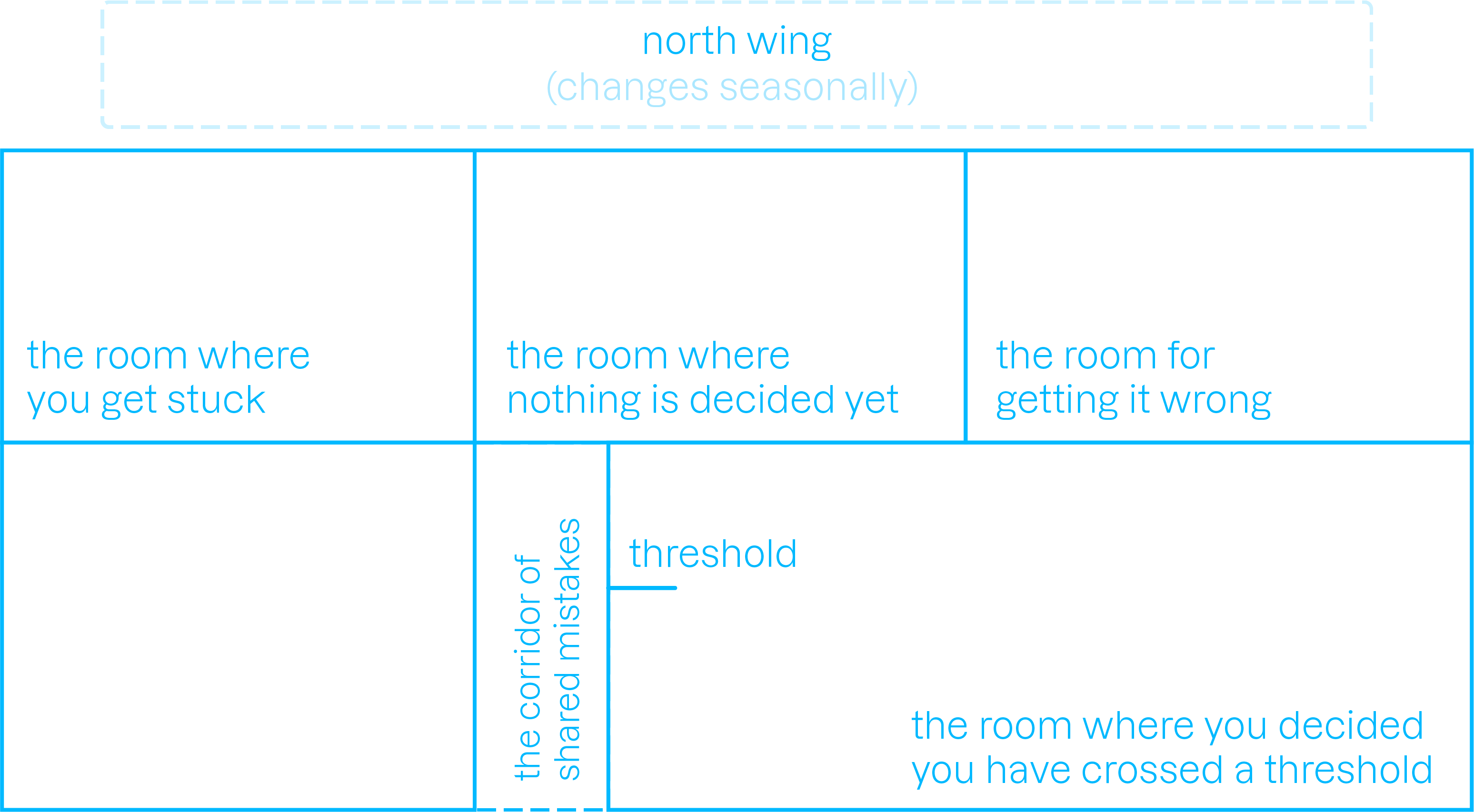
Floor plan: rooms of the Unfinished School

A folder pulled out of a drawer — four tabs, no fixed order. The school being built while it is being attended.

format
An open folder of recent thinking. Each tab is a sheet last touched on the date shown. Pull a tab from the right to read.
contents
School · Rules · Map · Folder.
status
Unfinished. Rules added as needed; rooms renamed as we learn what they're for.
Set in Lazzer-TRIAL (Medium, SemiBold, Medium Italic). Built as a folder, not a curriculum.
Pull a tab.
→ right side